Blog
7 Tips for Choosing Mine Exhaust Fans
Choosing Mine Exhaust Fans is a serious engineering decision, not a simple equipment purchase. Underground airways may stretch for kilometers, while heat, dust, moisture, and changing production levels affect ventilation performance. A fan that performs well in a surface test may struggle when connected to long ducting, bends, or restrictive regulators. Details matter.
This guide presents seven practical tips for selecting Mine Exhaust Fans with greater confidence. It considers airflow volume, static pressure, energy use, noise, maintenance access, control systems, and site conditions. Ventilation engineers typically review these factors together, rather than judging a fan by its motor size alone. Reliable selection begins with accurate mine data, including current headings, future extensions, and expected contaminant loads. Small calculation errors can become expensive underground problems.
There is no universal fan for every mine. That point is easy to overlook. A compact auxiliary fan may suit a short development heading, while a large exhaust system may require stronger pressure control and monitoring. Product specifications also need careful interpretation, especially when efficiency ratings use different test conditions. Buyers should request verified performance curves, service records, and clear installation requirements from qualified suppliers. Even then, assumptions deserve review. Real mines change, and ventilation plans must adapt with them. These seven tips offer a practical framework for comparing options, reducing avoidable risks, and supporting safer, more dependable airflow underground.
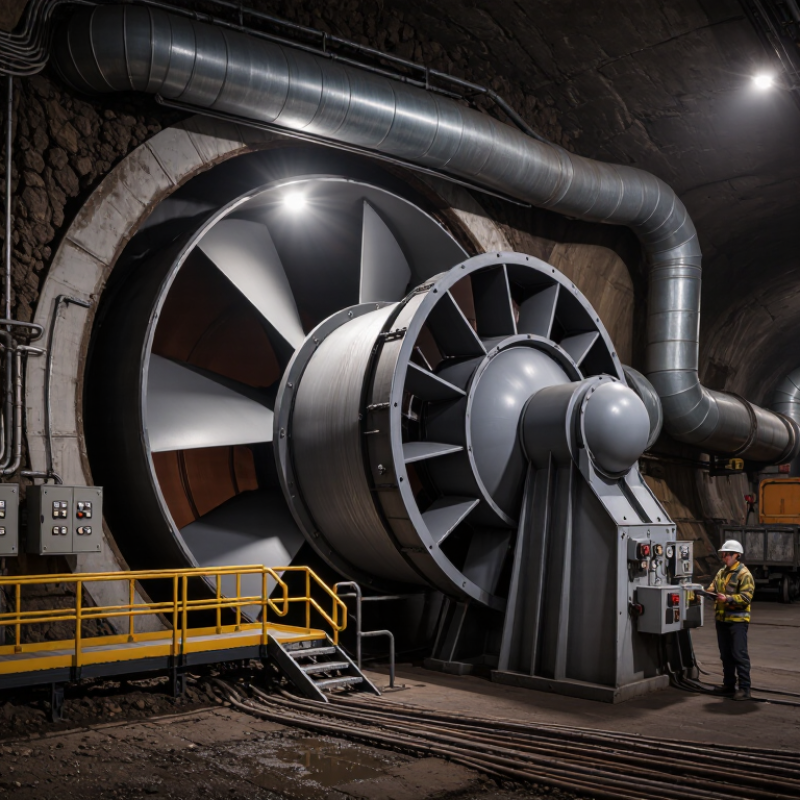
Understanding Mine Ventilation Needs and Exhaust Fan Functions
7 Tips for Choosing Mine Exhaust Fans
Understanding Mine Ventilation Needs and Exhaust Fan Functions
A mine exhaust fan is more than a large rotating machine. It controls airflow, pressure, heat, dust, and contaminants along working routes. Before selecting equipment, map each heading, shaft, intake, and return airway. Record airflow demand, static pressure, operating hours, and seasonal changes. These figures should come from competent ventilation surveys, not guesswork. A fan that performs well at the surface may struggle underground.
Tip: Define the ventilation duty. Calculate airflow for workers, equipment, heat removal, and clearance needs. Include leakage and future production changes. Small assumptions create serious performance gaps.
Tip: Match the fan curve to the mine system. Review volume, pressure, efficiency, stall margin, and controllability together.
Tip: Check the function. Main exhaust fans create pressure differences, while auxiliary fans support development headings. Reversible units may help during emergencies, but reversal time requires testing.
Tip: Examine the installation. Fan diameter, duct transitions, silencers, dampers, and discharge geometry can cause unexpected losses. I have seen a reliable fan underperform because a short, turbulent transition was overlooked.
Tip: Prioritize monitoring. Install sensors for airflow, pressure, vibration, temperature, and motor load.
Tip: Plan maintenance around bearings, impellers, drives, and controls. Dust builds quickly.
Tip: Verify performance after commissioning. Compare measurements with the ventilation plan and investigate deviations. No calculation stays perfect underground. Conditions change. Independent review by qualified ventilation engineers adds confidence as the mine expands.
Assessing Airflow, Pressure, and Fan Capacity Requirements
7 Tips for Choosing Mine Exhaust Fans
Assessing Airflow, Pressure, and Fan Capacity Requirements
Tip 1: Measure the mine before selecting the fan. Required airflow depends on diesel equipment, blasting fumes, heat, dust, leakage, and active headings. MSHA ventilation guidance requires mine operators to meet approved airflow and contaminant limits, not simply install a larger fan. Use calibrated anemometers at the face, return airway, and fan inlet. Record airflow under normal and peak production conditions.
Tip 2: Build a system-resistance curve. Include duct friction, bends, regulators, screens, stoppings, and leakage. A fan rated at 100,000 cubic feet per minute may deliver far less through a restrictive network. The U.S. Department of Energy’s fan-system guidance confirms that pressure rises with the square of speed, while power rises with the cube. Small speed increases can create major energy costs. Check the duty point carefully.
Tip 3: Match capacity with operational changes. NIOSH mining ventilation research emphasizes field measurement, contaminant control, and auxiliary ventilation performance. Select a fan that reaches the required airflow at the calculated pressure, with practical reserve capacity. Too much reserve can waste energy and increase noise. Too little capacity creates blind spots.
Tip 4: Verify performance after installation. Compare the fan curve with measured airflow and static pressure. I have seen designs fail because leakage was underestimated. The calculation looked precise. The mine was not. Recheck readings after duct extensions, equipment changes, and seasonal temperature shifts. Document the results for maintenance and safety reviews.
Comparing Fan Types, Materials, and Energy Efficiency
Mine exhaust fans must match the airway, duty point, and underground environment.
Tip 1: Compare fan types by operating pressure. Axial fans suit high airflow and moderate pressure. Centrifugal fans handle higher pressure and contaminated air more steadily.
Tip 2: Read the complete performance curve, not only the maximum airflow. MSHA ventilation guidance stresses maintaining required airflow under changing resistance.
Tip 3: Choose materials for corrosion and impact exposure. Galvanized steel offers strength and repairability. Fiberglass-reinforced plastic resists moisture and chemical attack, but needs careful inspection near joints.
Tip 4: Check temperature limits, bearing protection, and inlet screens. A common specification mistake is selecting materials before measuring the actual mine atmosphere.
Tip 5: Confirm the fan’s duty point after duct, bend, and leakage losses. NIOSH ventilation research repeatedly links leakage control with safer, more predictable airflow.
Tip 6: Prefer efficient motors and variable-speed control when demand changes. AMCA Publication 203 states that fan power follows the cube of speed. At 80% speed, ideal power falls to about 51%, nearly a 49% reduction. Real savings will be lower when controls and system resistance interfere.
Tip 7: Monitor airflow, pressure, vibration, and power continuously. The U.S. Department of Energy’s Fan System Assessment Tool recommends system-level evaluation, rather than judging motor efficiency alone. My own first-pass calculations have missed maintenance losses. Recheck them after installation.
Checking Safety Features, Standards, and Maintenance Access
7 Tips for Choosing Mine Exhaust Fans
Choose a fan around the real duty point, not its impressive catalog maximum.
Tip 1: verify airflow, pressure, gas conditions, and altitude through a witnessed performance test.
CRC Mining research reports that ventilation can consume 40–50% of an underground mine’s electricity. Efficiency matters, but dependable airflow matters more.
Tip 2: check motor efficiency, variable-speed control, and stable operation during partial loads.
Tip 3: require guards, emergency isolation, temperature monitoring, and vibration alarms.
MSHA recorded 40 mining fatalities in the United States during 2023, reinforcing the need for practical safeguards, not paperwork alone.
Standards should match the mine and its hazards.
Tip 4: review applicable MSHA requirements, including 30 CFR Parts 57 or 75, before approving equipment.
For explosive atmospheres, examine certification against the relevant IEC 60079 requirements. Confirm enclosure ratings, cable entries, earthing, and fault protection.
A certificate alone is not enough. Ask who tested it, under which conditions, and whether the installed configuration remains compliant.
This is where specifications can become surprisingly vague.
Maintenance access often decides whether a fan stays safe.
Tip 5: inspect doors, bearings, belts, dampers, and sensors without entering awkward spaces.
Tip 6: leave room for lifting equipment and safe isolation.
Tip 7: demand clear inspection points and replaceable wear parts.
On site, a blocked access panel can turn a ten-minute check into a postponed check. That is a design failure, though teams sometimes accept it.
Review noise, vibration, dust buildup, and emergency procedures during commissioning. Record baseline readings, then compare them after every major service.
Evaluating Installation Conditions, Costs, and Long-Term Reliability
7 Tips for Choosing Mine Exhaust Fans
Mine exhaust fans must match the shaft, airway, and operating environment.
Tip 1: Measure resistance, airflow, temperature, dust, and moisture before selecting equipment. A fan that looks efficient on paper may stall in a rough airway.
Tip 2: Check installation access carefully. Record shaft dimensions, lifting routes, electrical capacity, and emergency isolation points. MSHA ventilation guidance stresses dependable airflow and regular inspection underground. Small installation oversights can become expensive corrections.
Tip 3: Compare total cost, not purchase price. Include foundations, cabling, controls, commissioning, energy, and planned maintenance. NIOSH research commonly identifies ventilation as consuming roughly 30–50% of underground mine energy.
Tip 4: Request fan curves at the actual duty point. Do not rely on maximum airflow figures.
Tip 5: Examine efficiency across changing production conditions. The International Energy Agency reports that electric motor systems consume about 50% of global electricity, making inefficient fans costly over time.
Tip 6: Prioritize long-term reliability. Review bearing life, vibration limits, corrosion protection, spare-part access, and monitoring options.
Tip 7: Require a practical maintenance plan. It should define inspection intervals, cleaning methods, vibration alarms, and restart procedures.
A common field mistake is treating commissioning as the finish line. It is not. Dust loading, leakage, and seasonal temperature changes can alter performance. Budget assumptions also deserve a second look; optimistic energy savings rarely survive poor airflow control.
Article Source:
Exclusive Access
Unlimited Resources
Detailed information on our products to assist you with the planning of your cable management project
Register Now